On this page
- What "designing in ChatGPT" means in 2026
- Route 1: Generate images with ChatGPT Images 2.5
- Route 2: Use the Canva app inside ChatGPT
- Route 3: Connect a custom MCP design tool (Developer mode)
- ChatGPT design prompts that work
- Plan-by-plan cheat sheet
- ChatGPT vs Claude Design vs Canva AI
- Frequently Asked Questions
You typed "make me a flyer for Saturday's yoga class" into ChatGPT and got back a picture. A nice picture. But the date is wrong, the headline is a pixel blob you can't select, and when you ask for a fix the whole thing reshuffles. If that's your experience of ChatGPT design so far, the fix isn't a better prompt. In 2026 there are three ways to design inside ChatGPT, and they differ mostly in whether you end up with a flat image or an editable design. This guide covers all three, with steps, plan requirements and region limits.
What "designing in ChatGPT" means in 2026
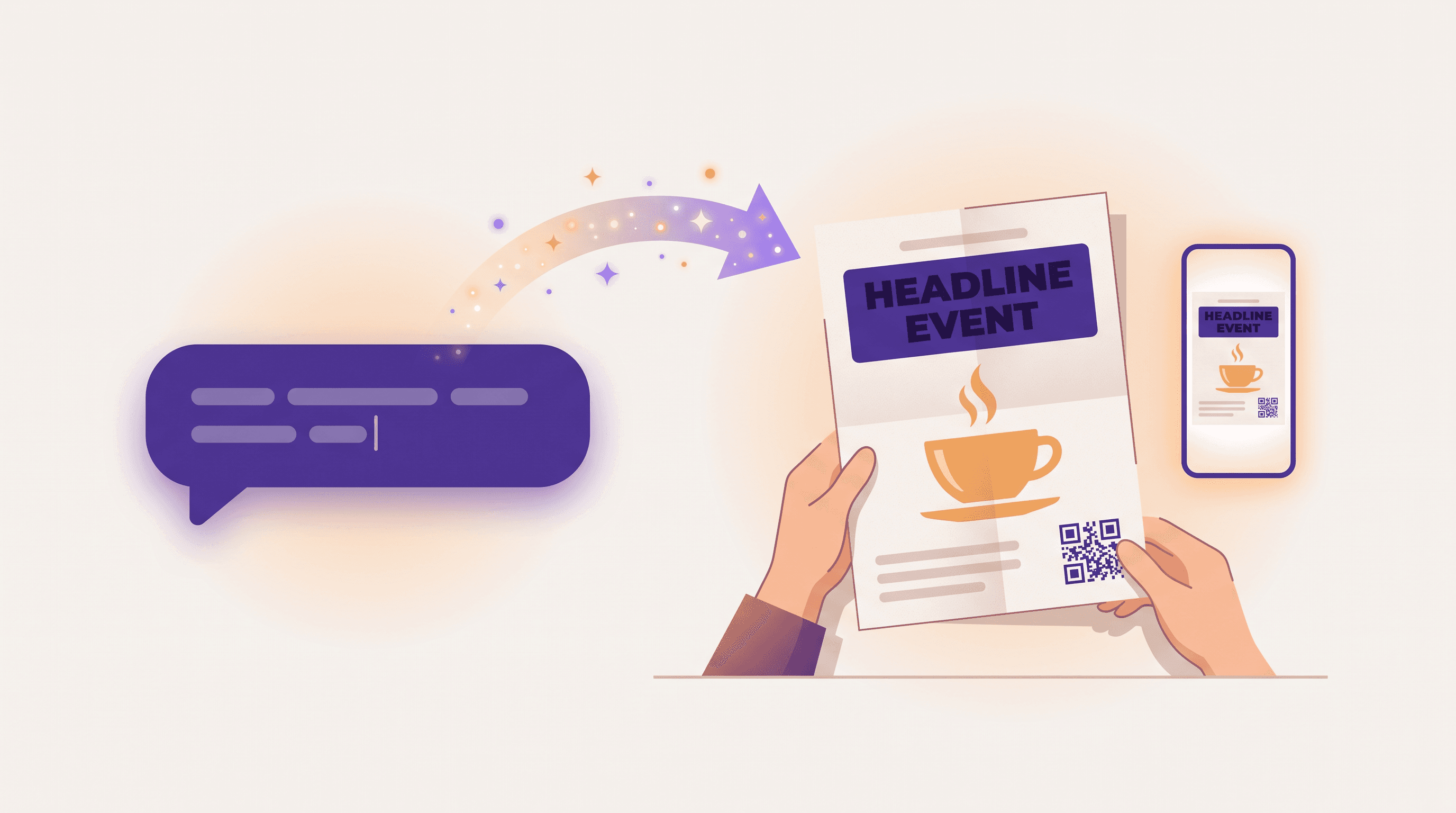
When people say they designed something in ChatGPT, they mean one of three things. Route 1 is the built-in image model, ChatGPT Images 2.5, which paints a single raster picture from your prompt. Route 2 is the Canva app, which builds a full Canva design inside the chat that you open in Canva to finish. Route 3 is a custom MCP connector, where ChatGPT talks to an outside design tool that builds a layered file in your own account.
The naming got messy this summer. OpenAI's help center says that as of July 9, 2026, the app directory became the Plugin directory, and a plugin "can include skills, apps, and app templates." Canva's help pages still call the same thing "Apps & connectors." Same feature, two labels, and all of it lives under Settings → Apps.
| Route 1: Images 2.5 | Route 2: Canva app | Route 3: Custom MCP tool | |
|---|---|---|---|
| What you get | One flat picture | A Canva design | A layered design in your tool's library |
| Editable layers? | No | Yes, in Canva | Yes, every element |
| Brand kit applied? | No | No (not inside ChatGPT) | Yes, if the tool has one |
| Export | Save the PNG from chat | Open in Canva to export | PNG, JPG, PDF from the tool |
| Plan needed | Free and up | Free and up (Canva Free, Plus, Pro) | Pro, Business, Enterprise officially; Plus reports it works |
| Region limits | None stated | Not available in China or the EU | None stated |

Route 1: Generate images with ChatGPT Images 2.5
ChatGPT Images 2.0 arrived on April 21, 2026 with what OpenAI called "improved text rendering, multilingual support, and advanced visual reasoning." Then ChatGPT Images 2.5 launched on September 8, 2026, and the headline improvement is editing: it's "better at editing only what you've asked for, while keeping the rest of the details the same." It's rolling out to every ChatGPT tier, including free.
A prompt formula for a flyer or social post
The image model rewards prompts that read like a creative brief: format and size, the exact text in quotes, the visual subject, the style, and the mood. Something like this:
"A 4:5 Instagram post for a neighborhood bakery. Headline text: 'Sourdough Saturdays'. Subtext: 'Fresh loaves from 7am, Elm Street'. A rustic loaf on a wooden board, warm morning light, cream and terracotta palette, clean sans-serif type, plenty of space around the headline."
Put the copy in quotes and keep it short; fewer words means fewer spelling accidents. For a second version, ask for one change at a time: "Same design, swap the loaf for croissants, keep everything else."
What it does well
For mood boards, hero imagery, and one-off visuals with three words of text or fewer, Images 2.5 is quick and often lovely. The 2.5 update means a "change just the headline" request has a real chance of changing just the headline. It's also the only route with zero setup.
Where it breaks
The output is a flat raster: no layers, no text boxes, no way to nudge a logo two millimeters to the left. Every revision is a fresh render, so even with the 2.5 improvements, details drift across a long session: fonts wander, colors shift, and a name spelled right in version three comes out wrong in version four.
Resolution is web resolution, not print resolution, so a poster or a menu will look soft on paper. And there's no brand memory: it doesn't know your fonts or hex codes, so every image starts from zero. The flyer prompts that survive this treat the image as a starting layer and finish the typography elsewhere.

Route 2: Use the Canva app inside ChatGPT
On June 3, 2026, Canva announced in its newsroom that "Canva now enables full design creation directly in ChatGPT – generate, edit, and preview designs without leaving the conversation." It's available on Canva Free, Plus and Pro, so yes, you can use ChatGPT with Canva.
Step 1: Connect Canva
In ChatGPT, open your profile menu, go to Settings → Apps, and find Canva in the directory. Click connect and sign in to your Canva account when the browser window pops up. ChatGPT will ask permission the first time it tries to use it.
Step 2: Ask for a design with @Canva
Start a new chat and type @Canva followed by a concrete request: "@Canva make an A5 flyer for a garage sale on Saturday 20 September, 8am to 2pm, 14 Birch Lane, bold and playful, yellow and black." ChatGPT passes that to Canva, which returns a design preview right in the thread.
Step 3: Edit in the chat
Keep going conversationally: "make the headline bigger," "swap to a blue palette," "add a line about free coffee." Each request updates the preview. This is where Route 2 beats Route 1: the text is real text in a real layout, so a headline change doesn't repaint the whole flyer.
Step 4: Open in Canva to export
When you're happy, open the design in Canva. That's where you download it as PNG or PDF and apply your brand settings. Exporting from inside ChatGPT isn't supported.
What the Canva app can't do
Canva's own help page is direct about the gaps. Exporting and applying brand settings only work in Canva itself. Magic Resize and Brand Kit are unavailable inside ChatGPT. And the app is not available in China or the EU.
One correction: Google's AI Overview for "canva chatgpt" currently claims the app works "using your brand kit." Canva's help page says the opposite. Inside ChatGPT you get Canva's defaults, and brand colors and fonts come in only after you open the file in Canva.
Route 3: Connect a custom MCP design tool (Developer mode)
The Model Context Protocol is an open standard that lets an AI app call tools in another product. ChatGPT supports it, so once you add a design tool's MCP server, you can ask for a design and get an editable file back in that tool's library instead of a picture in the chat. Our plain-English guide to MCP servers covers the basics.
Who can do this (the plan reality)
Read this part carefully. OpenAI's help article on Developer mode and MCP apps says that "Full MCP (Model Context Protocol) support, including modify/write actions, is rolling out in beta to ChatGPT Business, Enterprise, and Edu plans," and that "Pro users must continue enabling developer mode to use custom apps."
Then there's the contradiction. In an OpenAI community thread, an OpenAI staff member wrote that "write actions are available to everyone" and that "developer mode is not an enterprise level feature." Plus subscribers in the same thread report custom MCP servers working, with an occasional "blocked by OpenAI's safety checks" message on somewhere between 2 and 30 percent of calls.
So: officially Pro, Business, Enterprise and Edu. Plus users report it works through Developer mode, with the odd safety block. If you're on Plus, try it, but don't build a client deadline around it. Developer mode isn't listed for Free.
Step 1: Turn on Developer mode
On a personal account, go to Settings → Apps → Advanced Settings and switch on Developer mode. On a Business workspace, an admin does it under Workspace Settings → Permissions & Roles → Connected Data, where they'll find Developer mode and "Create custom MCP connectors." Once it's on, a "Create" option appears in the Apps section.
Step 2: Add the remote MCP server
Click Create, give the connector a name, and paste the server URL. Using Krumzi as the example, the URL is https://www.krumzi.com/api/mcp. Choose OAuth as the authentication method, save, and a Krumzi sign-in window opens. Approve it and ChatGPT now has design tools: generate_design, edit_design, export_design, get_brand_kit, and a few for listing existing designs. Full setup is on the Krumzi MCP page.
Step 3: Ask for the design, with your brand kit
Write the request the way you'd brief a designer, and mention the brand: "Using my brand kit, make a 4:5 Instagram post announcing our autumn menu launch on October 3. Headline 'Autumn on the Table', three dishes as the visual, warm and minimal." ChatGPT calls get_brand_kit first, then generate_design, and the design lands in your library in your fonts and colors. Over MCP this works for single images, carousels and multi-page PDFs. Video isn't supported over MCP, so that one still happens in the app.
Step 4: Revise and export
Ask for changes in the same thread: "Move the headline to the top, make the third dish bigger." That runs edit_design on the existing file rather than regenerating it. When it's right, say "export as PNG" (or JPG, or PDF for a multi-page piece). You can also open the design in the editor and drag things around by hand.
Why this route gives you editable, on-brand files
In Route 1, ChatGPT paints pixels. In Route 3, ChatGPT sends instructions and a design engine builds text boxes, image layers and shapes, then applies the brand kit. Every element stays selectable, so the "you can't select the headline" complaint disappears. The same idea works in Claude; the Claude connectors guide covers that setup, and there's a roundup of MCP servers for marketers if design is only one piece of your stack.

ChatGPT design prompts that work
Whichever route you use, the prompt does most of the work. Paste these as-is, then edit. For Route 2, put @Canva in front. For Route 3, add "using my brand kit."
Event flyer. "Make an A4 flyer for a community garage sale. Headline: 'Big Garage Sale'. Details: Saturday 20 September, 8am to 2pm, 14 Birch Lane. Bold and playful, yellow and black, big type readable from across a room, leave space for a small sponsor line at the bottom."
Instagram post. "Make a 4:5 Instagram post announcing a 20% off weekend for a candle shop. Headline: '20% Off All Weekend'. Subtext: 'Friday to Sunday, online and in store'. Soft cream background, one candle photo as the hero, calm and premium."
Instagram carousel. "Make a 5-slide 4:5 carousel titled 'Five signs your website needs a redesign'. Slide 1 is a bold hook, slides 2 to 5 are one sign each with a two-sentence explanation, consistent layout and colors across slides."
Web banner. "Make a 1200 by 300 banner for a SaaS homepage. Headline: 'Invoices done in 60 seconds'. One short button label: 'Start free'. Deep blue and white, clean and minimal, product-free, plenty of breathing room."
Pitch slide. "Make a single 16:9 slide titled 'Why now'. Three columns with short headers: Market, Timing, Team, each with one line of placeholder text. Dark background, one accent color, corporate but not boring."
Each one states a format, the exact text in quotes, one visual idea, a palette, and a mood.
Plan-by-plan cheat sheet
| Plan | Images 2.5 | Canva app | Custom MCP (Developer mode) |
|---|---|---|---|
| Free | Yes | Yes | Not listed |
| Plus | Yes | Yes | Not officially; users report it works with occasional safety blocks |
| Pro | Yes | Yes | Yes, via Developer mode |
| Business / Enterprise / Edu | Yes | Yes | Yes, full write actions in beta |
The Canva app excludes China and the EU regardless of plan. On Business, an admin switches on Developer mode at workspace level before anyone sees the Create button.

ChatGPT vs Claude Design vs Canva AI
The short version: ChatGPT has a built-in image model and now the Canva app, so it's the fastest place to get a picture. Claude has no built-in image model (see our post on whether Claude can generate images), but it supports connectors and suits the Route 3 workflow, where the assistant briefs a design tool. Canva AI, used inside Canva rather than inside ChatGPT, gives you Brand Kit and Magic Resize back, at the cost of leaving the chat.
For a one-off image, use Images 2.5. For a Canva design you'll finish in Canva, use the Canva app. For repeatable on-brand output with editable layers, use an MCP design tool from ChatGPT or Claude.
Frequently Asked Questions
Can I use ChatGPT with Canva for free?
Yes. Since June 3, 2026, the Canva app in ChatGPT works on Canva Free as well as Plus and Pro. The catches are that exporting and Brand Kit only work once you open the design in Canva, and the app isn't available in China or the EU.
Does ChatGPT give me editable designs or just images?
It depends on the route. ChatGPT Images 2.5 returns a flat picture with no layers. The Canva app returns a design you can edit in Canva, and a custom MCP connector to a tool like Krumzi returns a layered design in that tool's library where every text box and image is selectable.
Can ChatGPT make a flyer?
Yes, three ways. Images 2.5 will paint a flyer-shaped picture, fine for a quick social share but soft in print and hard to correct. The Canva app builds a real Canva flyer you export from Canva. An MCP design tool builds an editable, on-brand flyer and exports it as PDF, which is the only one of the three you'd send to a printer.
Which ChatGPT plan do I need for custom MCP connectors?
Officially, OpenAI lists full MCP support with write actions as rolling out to Business, Enterprise and Edu, with Pro users able to add custom apps through Developer mode. An OpenAI staff member has said write actions are "available to everyone," and Plus users report it working with occasional safety blocks. Developer mode isn't listed for Free.
What are some good ChatGPT prompts for graphic design?
The prompts that work state the format, the exact text in quotes, one visual subject, a palette and a mood. For example: "Make a 4:5 Instagram post announcing a 20% off weekend for a candle shop, headline '20% Off All Weekend', soft cream background, one candle as the hero, calm and premium." Ask for one change at a time when revising.
A month of posts, designed before your coffee cools
Describe the post. Krumzi designs it from scratch, on your brand, fully editable.
Start free trial3-day free trial, card needed. No charge until day 4. Cancel online anytime.